
By the ProSaaSLinks Team · Last reviewed: 16 October 2026
SaaS link building has an awkward problem. The pages that make you money (pricing, features, integrations, comparisons) are the ones almost nobody wants to link to. Bloggers link to research, tools and good explanations. They rarely link to a sales page.
So a SaaS link plan that works does two things at once. It earns links from places your buyers trust, and it moves that authority to your commercial pages through internal links. This guide covers the strategies we use for that, the rules that keep them safe, and a 30/60/90-day plan you can start this week.
Start with the rules, not the tactics
Before any tactic, read how Google defines the problem. Its spam policies for Google web search say: “Link spam is the practice of creating links to or from a site primarily for the purpose of manipulating search rankings.” The examples listed include buying or selling links for ranking purposes, “Excessive link exchanges”, automated link building, and links with optimized anchor text in guest posts.
Two points from the same policy matter most for SaaS teams:
- Paid links are allowed if they are labelled. Google accepts that paid links exist for advertising and sponsorship, and treats them as acceptable when they carry a
rel="nofollow"orrel="sponsored"attribute. Its guide to qualifying outbound links explains which value to use. - Link swaps are risky, including “ABC” exchanges. In an ABC exchange, site A links to site B, and B’s owner links back from a third site, C. The point is to hide a swap. It is still an arrangement made for ranking purposes, so we treat it as a link exchange and do not offer it.
The test we use most comes from Google’s own long-standing advice to site owners, which asks whether you would do something if search engines didn’t exist. For links, we ask: would this link still make sense with no search engines at all? If the answer is yes, because it helps a reader, comes from a real relationship or points to something useful, the tactic is usually sound.
Step zero: decide which pages need links
Sort your site into three groups before you contact anyone:
| Group | Examples | How they get authority |
|---|---|---|
| Money pages | Pricing, feature, integration, comparison, alternatives and use-case pages | Mostly through internal links, plus a few direct links from lists and partners |
| Bridge pages | In-depth guides and how-to articles on the problem your product solves | Guest posts, expert quotes and link insertions point here, and these pages link on to money pages |
| Linkable assets | Original data, free tools, templates, benchmarks | Earned through outreach and PR |
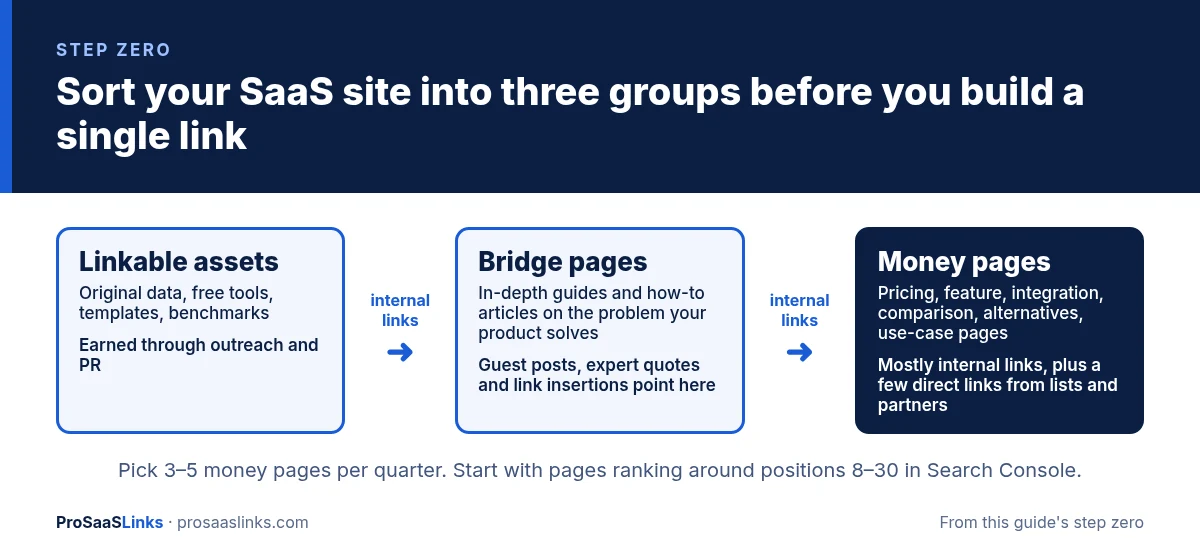
Then pick three to five money pages to focus on this quarter. Start with pages that already rank somewhere between position 8 and 30 in Google Search Console. They are close enough that a few good links and better internal linking can move them.
10 SaaS link building strategies that hold up
1. Claim the links you are already owed
Most SaaS companies have links waiting for them that nobody has asked for. Look for:
- integration partners’ app marketplace and directory pages
- tech partner or “works with” pages
- investor, accelerator and programme portfolio pages
- customers who mention your product in their own docs or case studies
- review profiles and software directories your buyers actually use
Each of these sites already knows you, so a link there is relevant from the start, and asking for one feels like fixing an omission rather than cold outreach.
2. Turn unlinked mentions into links
Set up brand-name alerts and search for your product name on its own, without your domain. When an article mentions you without a link, send a short note to the author. Thank them, and suggest the most useful page on your site for their readers. This is usually a docs page or a guide, not your homepage.
3. Recover links that point to dead pages
Export the pages on your own site that have backlinks, then check which ones return a 404. Every old feature page, retired pricing page or deleted blog post with links pointing to it should get a 301 redirect to the closest live page. This is the fastest link work you can do, because the links already exist.
4. Get into the “best X” and “X alternatives” lists
Buyers, and AI answer tools, read comparison lists. Find the lists that rank for your category and for your competitors’ names plus “alternatives”. Then send each author a short, factual note: what your product does, who it suits, your public pricing and one honest weakness. Authors update lists when it is easy. Make it easy for them, and never offer payment for a place in a list without a disclosure.
5. Offer expert commentary to journalists
Platforms that connect journalists with sources are full of requests from people writing about software, security, remote work and finance. Answer the questions your team can genuinely answer, in two or three useful sentences with a name and a job title. It is slow work at first, but every published quote is an editorial mention on a real publication.
6. Publish one data asset per quarter
Your product sees patterns no one else can see. Anonymised and aggregated, a small benchmark (“median time to first value across X accounts”) is something writers want to cite. Be strict about the method: state the sample, the time period and the limits. One solid asset each quarter beats a monthly stream of thin “statistics” posts. We plan to publish our own research on SaaS link pricing once we have enough first-party data to do it properly.
7. Write guest posts for publications your buyers read
Guest posts remain useful when they are genuine writing for an audience that matters to you. Pick publications by audience first and authority second. Link to a bridge page that helps the reader, using your brand name or a plain description as the anchor. We keep a list of SaaS and B2B guest posting sites with live contributor guidelines, along with the ten-minute vetting check we run on any site before we pitch.
8. Use link insertions carefully
Asking an editor to add your resource to an existing article can be the most relevant link you get, if it improves the article. Examples are a better source, an updated statistic or a working tool to replace a dead link. If the publisher asks for a fee, the link should be qualified as sponsored, and you should follow the publisher’s own policy. An insertion that adds nothing for the reader is the kind of link the spam policy describes.
9. Co-market with integration partners
Joint webinars, integration guides, shared templates and launch announcements create links on both sites that make sense to readers. Partners also have a reason to keep these links live, because the content helps them sell too.
10. Route authority with internal links
Every page that earns links should link on to a related money page, with a descriptive anchor that tells the reader what they will find. Google’s link best practices describe good anchor text as “descriptive, reasonably concise, and relevant to the page that it’s on and to the page it links to”, and warn against cramming keywords into it. Vary the wording naturally, and let the sentence around the link give it context.
Anchor text: let the sentence decide
Plenty of SaaS link problems have nothing to do with the sites. They come from the anchors. Google’s spam policies name optimized anchor text in guest posts and articles as a form of link spam, and a backlink profile where dozens of sites link with the same commercial phrase is easy to spot.
We do not work to anchor-text percentages. We use four plain kinds of anchor and let the editor’s sentence decide which one fits:
- Your brand or product name, which is what most writers use anyway.
- The bare URL or domain, common in resource lists and source notes.
- A description of the page, such as “this onboarding checklist” or “their guide to SOC 2 audits”.
- A topic phrase, but only when the publisher wrote it that way and it reads naturally.
A quick test: read the sentence aloud to someone who has never heard of SEO. If the linked words sound like a search query rather than part of the sentence, change them.
To check your existing profile, export the anchors from your backlink tool and sort them into those four groups, plus a fifth for exact-match commercial phrases. If that fifth group is large, stop adding to it, and ask for changes on links you or a past vendor arranged. Don’t reach for the disavow tool by default. Google’s disavow guidance says most sites will never need it, and that it is meant for cases with many artificial links that have caused, or are likely to cause, a manual action.
What we do not do, and why
- Private blog networks and link farms: they are built to manipulate rankings, so they carry most of the risk and offer little real value.
- Link exchanges, including ABC schemes: excessive exchanges are named in Google’s policy, and hiding them across three sites does not change what they are.
- Sitewide footer or widget links: also named in the policy.
- Exact-match anchors at scale: brand names, page titles and plain descriptions read naturally and age well.
- Ranking guarantees: nobody controls Google’s results.
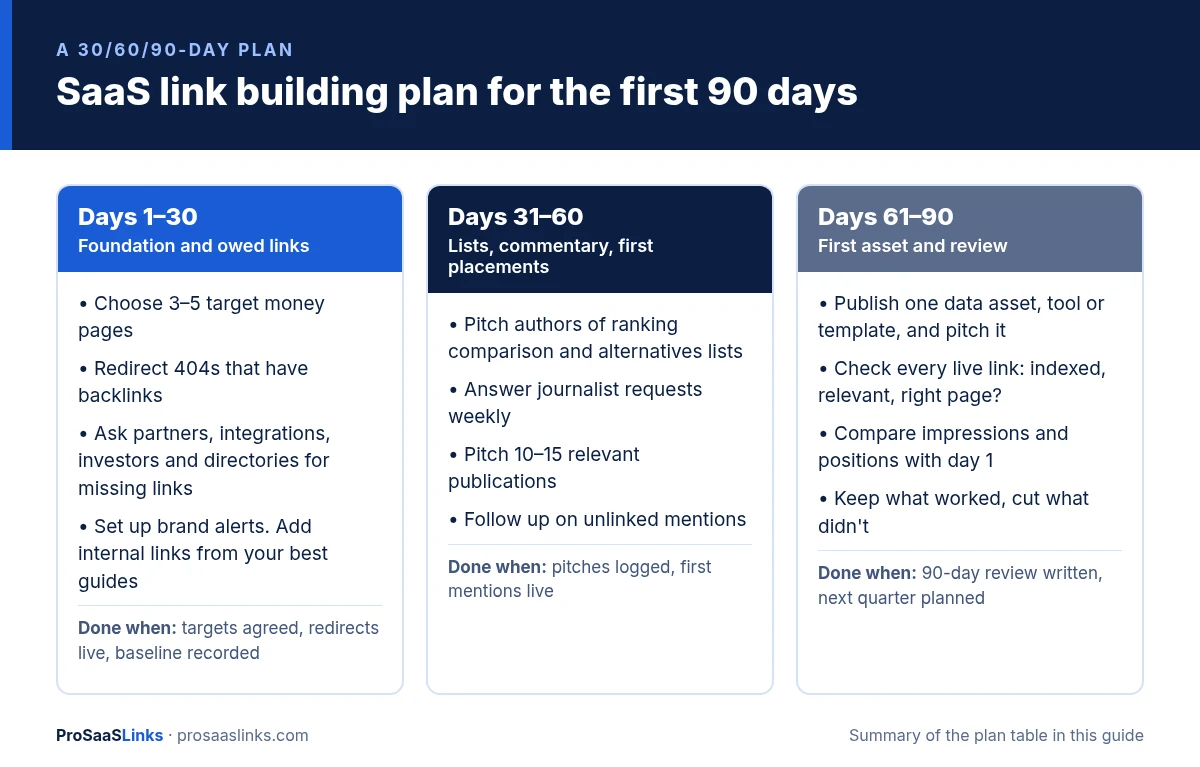
A 30/60/90-day SaaS link building plan
| Phase | Focus | Tasks | Done when |
|---|---|---|---|
| Days 1–30 | Foundation and owed links | Choose 3–5 target money pages. Fix 404s that have backlinks. List every integration, partner, investor and directory page and ask for the links that are missing. Set up brand alerts. Add internal links from your best guides to the target pages. | Target list agreed. Redirects live. Partner requests sent. Baseline recorded in Search Console. |
| Days 31–60 | Lists, commentary and first placements | Pitch the authors of the comparison and alternatives lists that rank in your category. Answer journalist requests every week. Pitch 10–15 relevant publications with specific angles. Follow up on unlinked mentions. | Pitches logged with replies tracked. First editorial mentions and placements live. |
| Days 61–90 | First asset and review | Publish one data asset, tool or template, and pitch it to writers who cover the topic. Check every live link: is it indexed, relevant and pointing to the right page? Compare target-page impressions and positions with your day-1 baseline. Keep what worked, cut what didn’t. | Asset live and pitched. 90-day review written. Plan for the next quarter set. |
How to measure whether it is working
- Referring domains to each target page, not only to the whole site. You can see these in the Links report in Google Search Console and in your SEO tool.
- Impressions and average position for the queries each target page is meant to rank for.
- Sign-ups and demo requests from those pages, tracked as key events in your analytics.
- Quality of each link: live, indexed, on a relevant page, with a natural anchor. Removing one bad link from your plan is worth more than adding three weak ones.
Expect this to take time. Links usually affect rankings over months, not weeks, and the results depend on your competitors as much as on your own work.
Doing it in-house or with a partner
Strategies 1 to 4 and 10 suit most in-house teams, because they rely on relationships and access to your own site. Steady placements on relevant publications take outreach time that many SaaS marketing teams do not have, and the same is true for agencies serving several SaaS clients.
If you are weighing up outside help, start with our side-by-side look at 13 SaaS link building providers, which discloses that we compete with all of them. It lists the public prices and terms of 13 providers, including what each one does not publish. If you want to see how we work, read about our SaaS guest post, link insertion and white-label services, compare our monthly link building plans, or learn who ProSaaSLinks works with.
Get a free link plan for your target pages
Tell us your site and the three to five pages you most want to grow. We will reply with a free link plan: which of the strategies above fit those pages, what kind of sites to aim for, and what to fix first.
Frequently asked questions
What is the best link building strategy for a new SaaS company?
Start with the links you are already owed (partners, integrations, directories, investors) and fix any 404 pages that have backlinks. They cost little, and the sites involved already have a real connection to your product. After that, add list inclusion and expert commentary.
Are paid links against Google’s rules?
Paid links that pass ranking credit are listed as link spam. Paid links qualified with rel=”sponsored” or rel=”nofollow” are not a violation, according to Google’s spam policies.
Is an ABC link exchange safe?
We do not consider it safe. It is a link swap arranged for ranking purposes, routed through a third site so it is harder to spot. Google’s policy names excessive link exchanges as link spam.
How many links does a SaaS page need to rank?
There is no fixed number. Look at the referring domains of the pages that rank above you for your target query. Then aim for links that are more relevant than theirs, not just more of them.
See all posts on the ProSaaSLinks blog · ProSaaSLinks: SaaS link building for B2B software companies