
By the ProSaaSLinks Team · Last checked: 16 October 2026
Most “SaaS guest posting sites” lists go stale within months. Contributor pages get taken down, editors move on, and a site that took good guest articles last year may now only sell sponsored slots. So this page does two jobs. First, it gives you a short list of SaaS, B2B and tech publications whose contributor guidelines we checked were live on the date above. Second, it shows you how we decide whether a site is worth a pitch at all, so you can judge any list, including ours.
One honest note before the list: none of these publications is a ProSaaSLinks partner, and we have not been paid to include them. We have not checked their traffic or authority for this page. Read their own guidelines, and run the checks in this guide before you pitch.
Quick answer: where to start
- Product, onboarding and customer success topics: Userpilot, Instatus and EveryAny.One take practitioner articles from people who build or run software.
- Cloud, security and DevOps: Compare the Cloud, Techwrix, DevOps.com, Security Boulevard, Infosecurity Magazine and Cybersecurity Dive. Most of them want a short pitch first and strongly prefer exclusive, opinion-led pieces.
- B2B growth and SaaS marketing: Gripped, Pepper Cloud, Opt-4, SaaSClue and Lilach Bullock’s blog want a real result, real numbers or a lesson you learned the hard way.
- UK audiences: Compare the Cloud, Gripped, Opt-4 and Pepper Cloud (which asks for UK English) are good places to start.
The list: SaaS and B2B publications with live contributor guidelines
We checked each guidelines page on 16 October 2026. “Checked live” means the page loaded for us. “Seen in search index” means the site blocked our automated check, but a search index returned the page’s current text on the same day. Before you pitch, open the page yourself: guidelines change without notice.
| Publication | Topics it covers | What its guidelines ask for (summary) | Check on 16 Oct 2026 |
|---|---|---|---|
| Userpilot blog | Product management, UX, customer success, SaaS case studies | At least 800 words (1,500 to 2,000 preferred), visuals included, sent as an editable Google Doc. Allows one link to your company and a few outbound links. | Checked live |
| Instatus blog | SaaS, product, customer success, software development, DevOps | Practical ideas, case studies and interviews. Send finished articles to the editorial email on the page. | Checked live |
| Incredo blog | SaaS marketing and growth | Sets minimum requirements for the contributor’s own website. Limits outbound links, allows only one followed link and asks for an internal link to its own content. | Checked live |
| EveryAny.One | SaaS business, software buying and operations | Wants writers with first-hand experience of building, selling or running software. Takes full articles and short expert contributions. | Seen in search index |
| Compare the Cloud (UK) | Cloud, AI, cybersecurity, data, enterprise IT | Practitioner opinion and vendor-neutral analysis. Pitch an outline before you write. | Checked live |
| Techwrix | Cloud, security, DevOps, enterprise software and SaaS | Pitch first with a headline, summary and writing samples. The site also sells commercial partnerships, so ask which kind of placement you are getting. | Checked live |
| DevOps.com | DevOps, DevSecOps, cloud, continuous delivery | Apply through a contributor form with a bio and a topic idea. The editors decide where a piece is published. | Seen in search index |
| Security Boulevard | AppSec, cloud security, DevSecOps | Contributor request route for security practitioners. | Seen in search index |
| Infosecurity Magazine | Information security | Exclusive op-eds of about 800 to 1,000 words. No sales pitches. Send a synopsis first. | Checked live |
| Cybersecurity Dive | Cybersecurity industry opinion | Exclusive opinion pieces of about 1,000 words. AI-written submissions are not accepted. The editors contact you only if they accept your piece. | Seen in search index |
| Gripped (UK) | B2B tech and SaaS growth | One followed link to your site and links to some of its own posts. The editors reply only to pitches they accept. | Checked live |
| Pepper Cloud | B2B sales, marketing, SME growth | Original, data-backed posts of up to about 1,500 words in UK English, with a small number of links. | Checked live |
| Opt-4 (UK) | SaaS growth, B2B marketing, cloud, security | Original articles of 1,000+ words with sources. Submit through the site’s contact form. | Seen in search index |
| SaaSClue | SaaS metrics, finance, valuation, operations | Long, data-backed pieces built on operating experience. Check the site’s traffic yourself before you invest the time. | Checked live |
| Lilach Bullock (UK) | SaaS marketing campaigns | Campaign write-ups that show the spend, the channel and the result. Theory pieces are declined. | Checked live |
Notice what is missing: domain ratings and traffic numbers. They change every month and depend on which tool you use. If we printed one, it would be out of date before you read it. The next section shows how to check them yourself in ten minutes.
How we vet a SaaS guest posting site before we pitch
When a site looks promising, we run the same short check every time. It takes about ten minutes, and it saves us from writing 1,500 words for a page that nobody will read.
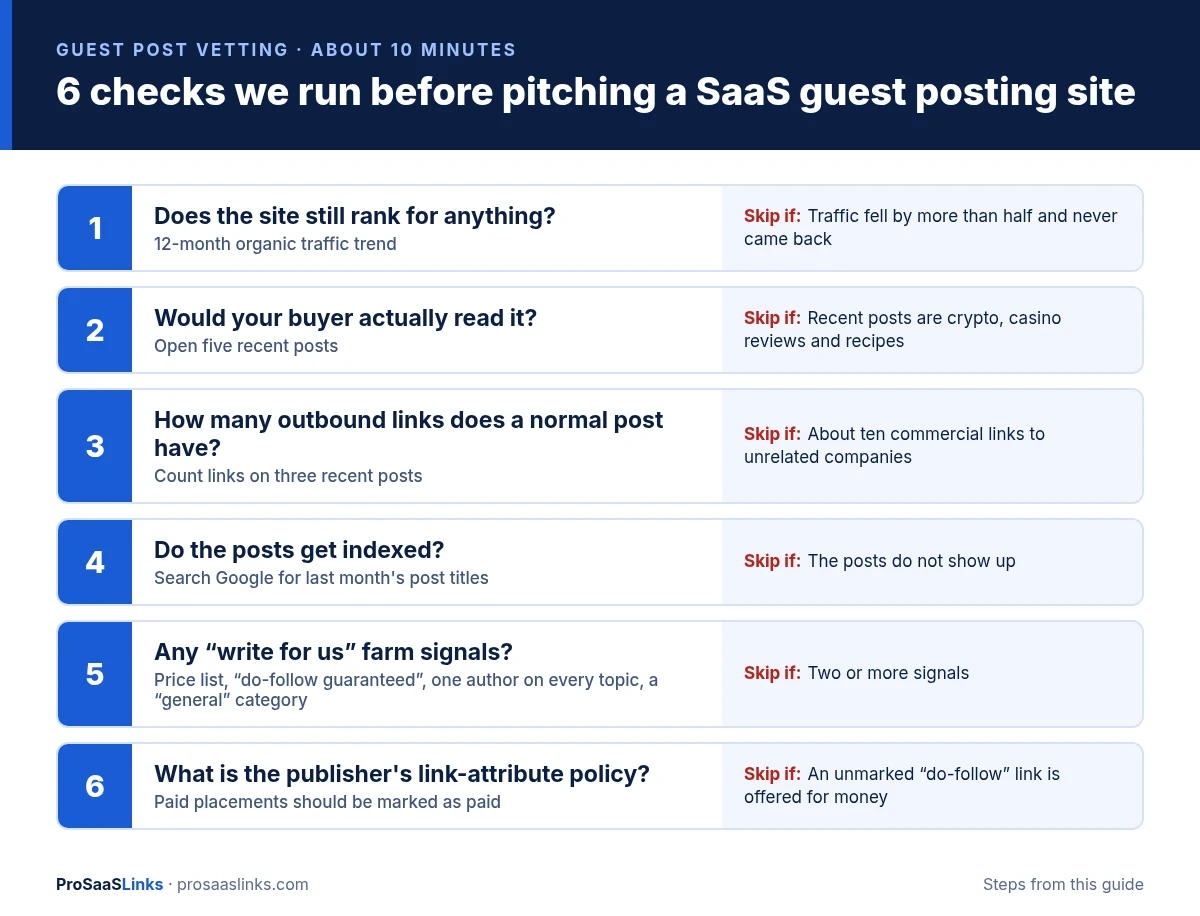
1. Does the site still rank for anything?
Look at the site’s organic traffic trend over the last 12 months in whichever SEO tool you use. A steady or rising line is fine. A cliff edge, where traffic fell by more than half and never came back, usually means a quality problem. We skip those sites, however good the authority score looks.
2. Would your buyer actually read it?
Open five recent posts. Ask yourself: would a product manager, a RevOps lead or a CTO at a company like your customer’s read this? If the last five posts cover crypto, a casino review and a recipe, the site writes for whoever pays. Its readers are not your buyers.
3. How many outbound links does a normal post have?
A healthy contributed post links to a few sources. A post with ten commercial links to unrelated companies is a link page with a story around it. We count the links on three recent posts before we decide.
4. Do the posts get indexed?
Search Google for the exact title of a post from last month. If the posts are not indexed, a link from them is unlikely to be found or counted.
5. Are there clear “write for us” farm signals?
Watch for a price list on the guidelines page, “do-follow guaranteed” wording, the same author on every topic, or a category called “general”. Any one of these is a warning. Two or more and we move on.
6. What does the publisher say about link attributes?
If you pay for a placement in any form, Google expects that link to be marked as paid. We cover this in the next section. A good publisher has a clear policy. A site that promises you an unmarked “do-follow” link in exchange for money is asking you to carry its risk.
Guest posts and Google’s rules: what to know before you pitch
Guest posting is not against Google’s rules. The problem is guest posting done mainly to pass ranking signals. Google’s spam policies name “links with optimized anchor text in articles, guest posts, or press releases distributed on other sites” as an example of link spam, together with paid links that pass ranking credit. Google also explains that paid or sponsored links are fine when they are marked: it says such links are not a violation “as long as they are qualified with a rel=”nofollow” or rel=”sponsored” attribute value”. You can read both points in Google’s spam policies for web search and its guide to qualifying outbound links.
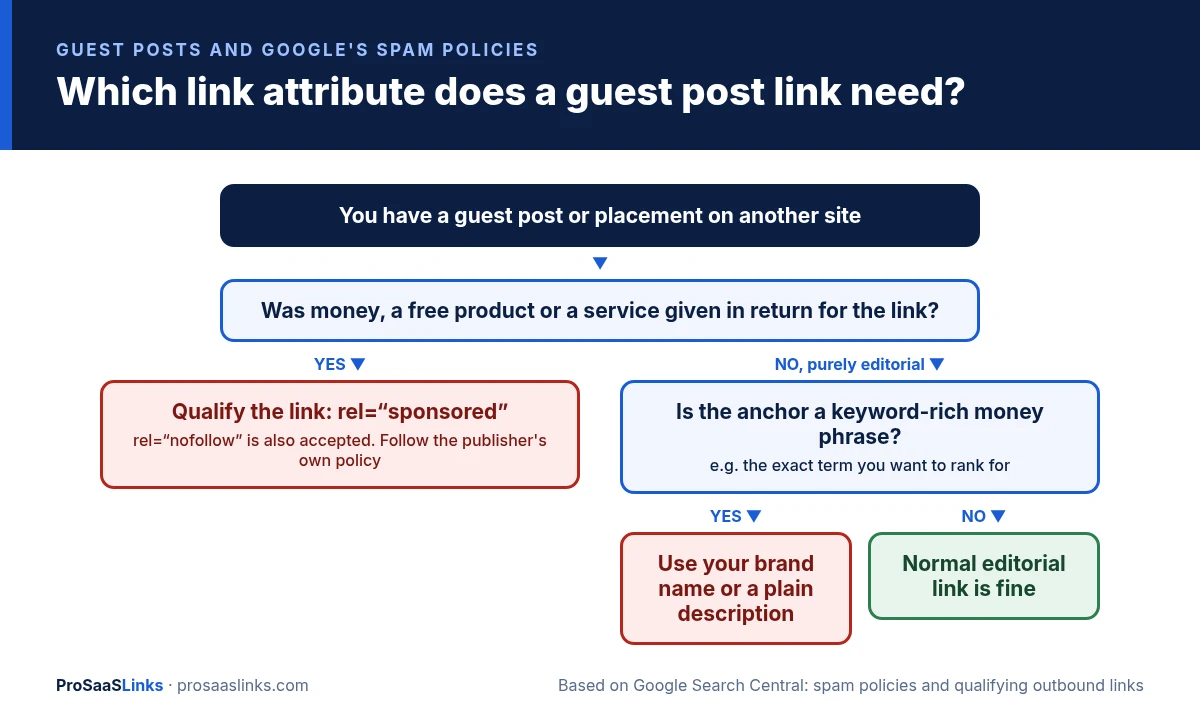
In practice, our rules are simple:
- Write for the publication’s readers first. If the article would not be worth publishing without your link, it is not worth publishing with it.
- Use natural anchors. Your brand name, a page title or a plain description of the page. Avoid exact-match commercial phrases.
- Link where it helps the reader. A link to a relevant integration guide or a feature explainer reads naturally. A homepage link with “best CRM software” as the anchor does not.
- If money changes hands, expect the link to be qualified. Follow the publisher’s own link policy, and ask what attribute the link will carry before you agree.
For the wider picture of where guest posts fit next to digital PR, partner pages and link reclamation, see our guide to SaaS link building strategies that stay inside Google’s rules.
How to pitch a SaaS publication (and get a reply)
Editors at good SaaS and B2B publications get far more pitches than they can use. The pitches that get a reply tend to share four things.
- A specific angle, not a broad topic. “How we cut onboarding drop-off by changing one step” beats “Tips for better onboarding”.
- Proof that you have done the work. A screenshot, a before-and-after metric you can share, or a short process the reader can copy.
- An honest sign that you know the site. Mention a recent post and how your piece adds to it, rather than repeating it.
- A short pitch. A working title, three or four bullet points for the outline, and one line on why you can write it. No attachments on the first email.
Then send one polite follow-up after about a week. If there is still no answer, move on. Many editors only reply to pitches they accept, and several of the publications above say so on their guidelines page.
Which of your pages should a guest post support?
For most SaaS companies, the pages that bring sign-ups and demos are feature, integration, comparison, alternatives and use-case pages. Very few writers link to a pricing page on their own. A practical approach is to link from the guest post to a useful resource on your site, such as a guide or a template, and then link from that resource to the commercial page with good internal links. Readers who click get something useful, and the authority still reaches the pages that bring in revenue.
Doing this yourself vs. getting help
If you have one writer, a few hours a week and a narrow niche, pitching publications yourself is a good way to learn what editors want. It gets harder when you need consistent placements across many pages, or when you are an agency delivering for several SaaS clients at once.
That is the work ProSaaSLinks does. We find relevant SaaS, tech and B2B sites, check them with the steps above, and show you each site before anything goes live. You can see how this works on our SaaS guest post and link insertion services page, compare the monthly link building plans and what each one includes, or read who we are and what we will not do. If you are comparing providers, our disclosed comparison of SaaS link building agencies lists the public facts for each one, including ours.
Get a shortlist of publishers for your niche
The list above is general. If you tell us your product category, your target market (US, UK, Canada or EU) and the pages you want to grow, we will reply with a shortlist of publishers we have checked for that niche, plus the angle we would pitch to each one. It is free, and there is no obligation to buy anything.
You will reach our contact page. We only use your details to reply to your request.
Frequently asked questions
Are SaaS guest posting sites still worth it?
Yes, when the site has real readers in your market and the article is useful on its own. Guest posts are a poor choice when the main goal is the link and the site exists mainly to sell placements.
How many guest posts does a SaaS site need?
No fixed number is right. It depends on how strong the pages you compete with are. Start with a few placements on very relevant sites, measure them in Google Search Console for a few months, and then decide whether to do more.
Should a guest post link be “dofollow”?
If the placement was paid for in any form, Google expects it to be marked with rel=”sponsored” or rel=”nofollow”. If it was earned on editorial merit, the publisher decides. Always follow the publisher’s own link policy.
How often is this list updated?
We plan to recheck every publication on this page each quarter and update the “last checked” date at the top. If a page goes offline, we remove it.
More SaaS link building guides on the ProSaaSLinks blog · ProSaaSLinks home